Empathy for Robots in Space (Veronica Vold)
I’ve often imagined what it might be like to be alone in outer space: the loneliness, the vastness, the un-homeness of it. Perhaps this is why the recent xkcd comic, “Spirit,” affects me so deeply. Cartoonist Randall Munroe gives NASA’s robot thought bubbles and the capability to hope. A feeling of loss radiates through these bursts of robot voice: his confusion and despair at being abandoned recalls Dug the dog in Up (“I was hiding under your porch because I love you”). Yet it’s his silence in the final panel that really evokes the sadness of dislocation for me; Spirit is alone, embedded in the alien landscape of Mars. And: he’s still out there right now! Munroe’s conception of Spirit makes me think of Wall-E; why is it so easy to identify beings in machines that are initially meant to be dutiful drones? Such robots cross a boundary to become cyborgs of emotional depth, capable of friendship and companioning with people. Reading Munroe’s comic, I want to step into this foreign landscape, look into Spirit’s goggles, and tell him to come home: we’re all waiting.
“Trailhead”: E.O Wilson and the ants
“The instincts of the are very unimportant, considered as the ant’s; but the moment a ray of relation is seen to extend from it to man, and the little drudge is seen to be a monitor, a little body with a mighty heart, then all its habits, even that said to be recently observed, that it never sleeps, become sublime.”
– Ralph Waldo Emerson, Nature (1836)
E.O. Wilson’s first novel Anthill attempts to do something that Wilson (as he explained in this interview with New Yorker fiction editor Deborah Treisman) thinks no novelist has done before: “describe the natural world as it actually is, in fine detail—indeed, maybe as it could best be seen by a biologist who’s spent a substantial career studying it in fine detail—but put it as part of the human experience.” Explaining the project further, Wilson continues; “I actually tried to make the natural world—that contested lot of old-growth forest that’s the center of the novel—of equal importance, almost equal importance as the human protagonist.” Wilson’s description seems to fit the guidelines of what makes an “environmental text” as first laid out by Lawrence Buell in The Environmental Imagination (1995). However, whether or not it is environmental, the novel’s success as a piece of literature is another question.
The novel won’t be out till spring, but Wilson recently made his début in the New Yorker as a fiction writer with an excerpt from the book: this short story titled “Trailhead.” Infused with human drama reminiscent of the Iliad and other epics, the story follows a single ant colony through its birth and eventual siege and destruction by an “enemy” colony. As Wilson notes in the interview, ants live in “the most advanced social system that exists on Earth outside of human beings.”
Blog Shout-out and CFP
Over the break, I was a hyperlink fiend, following up on blogs that I’d put off reading all term, but also discovering new ones. Here’s my top five that relate to our interests:
5. Origins Sponsored by the American Association for the Advancement of Science, this yearlong blog celebrated the 150th anniversary of the publication of The Origin of Species. Though the year and the blog have ended, the site may be a good future resource.
4. Bioephemera. An art and biology-focused blog by Jessica Palmer, who practices both.
3. Mapping the Marevlous. Marion Endt’s blog explores natural history, taxonomy, and surrealism. The site features beautiful pictures and consistently intriguing rare archives.
2. We Have Never Been Blogging. A Bruno Latour blog managed by Evan Kindley, Mike Johnduff, and Paul Ennis. Born roughly the same time as our blog, this blog explores theoretical questions surrounding Latour and other Speculative Realism.
1.The Book of Barely Imagined Beings. A highly accessible digital bestiary, featuring a wide range of macro- and micro-fauna. Caspar Henderson navigates ecology, evolutionary biology, natural history, folklore, and literature, providing memorable quotes and images along the way.
————
Call for Party: Robot Love
Eugene, OR, Janet Smith House
St. Valentines Day is fast approaching, but why should humans hoard all the good feelings? Taking cues from Donna Haraway’s “Cyborg Manifesto,” other course readings, and 1980’s prog-rock meditations, this party seeks participants willing to groove, perform, and celebrate the physical and emotional connections (whether fleeting or enduring, generative or inconceivable) between human and robotic kinds. “Love,” broadly conceived, includes friendship, fetishes, altruism, romance, affection, obsession, etc. Costumes may explore human loving robots, robot loving robots, and robot loving humans. Android, cyborg, cylon, and a.i. partners are also welcome expected.
Deadline: Saturday, January 23, 2010
For further inquiry, drop me an email.

Looking forward to 2010: Cyborgs, Copenhagen, and Calamity
Rebecca Solnit, in her recent brilliant piece up on the HuffingtonPost, draws interesting comparisons between the film Terminator 2 and what the recent events (failures would be a better word) at Copenhagen say about where we are right now with the climate crisis. The essay is definitely worth reading if you have the time as it alludes to many of the topics we discussed in 670 this past term: risk and disaster, apocalypse, climate change, cyborgs, and environmental justice. As we move forward into the new decade, let’s hope that Solnit’s tempering of anxiety with hope, her mixing of apocalyptic rhetoric with more empowering emotions, is a sign of things to come and of new environmental imaginations, whether mainstream or subcultural, that can help people make sense and take meaningful action on our complex environmental realities, like climate change. And hopefully the “next” Copenhagen (if there is one) will not be such a failure. Happy New Year!
Parliament of World Religions Statement to Copenhagen
A clip of the statement by Bishop Geoff Davies of South Africa, a prominent preacher, activist, and environmentalist, calling for the 350 target and for a renewed ethical stance towards climate change. It was delivered at this month’s Parliament of World Religions, which is being held in Melbourne. The parliament is the largest interreligious conclave on earth.
The buzz…
I have never heard so much about Copenhagen in my entire life…
Of course, this is because the current climate conference is probably the most newsworthy thing happening right now. And I’m not complaining. There are so many levels, in terms of science, economics, globalism, etc, that pretty much any report I hear on NPR or read on the Internet is fascinating.
The Human in Natural Sacred Landscapes
 Recently I’ve been thinking about manmade landscapes in relation to my research on the Croagh Patrick pilgrimage, and the more I think about it, the more I realize how much human interaction with the mountain and its surrounding area has been essential to its status as a sacred site. On its own, Croagh Patrick has a striking and imposing presence which is likely why it has attracted pilgrims for thousands of years (pre-Christian and later on, Christian). But once that initial engagement began, human interaction with the mountain began to change it. One way in which this occurred was the creation of three cairns on the shoulders of the mountain, which may be burial cairns or simply monuments erected by ancient peoples (they have never been excavated, so it is hard to tell).
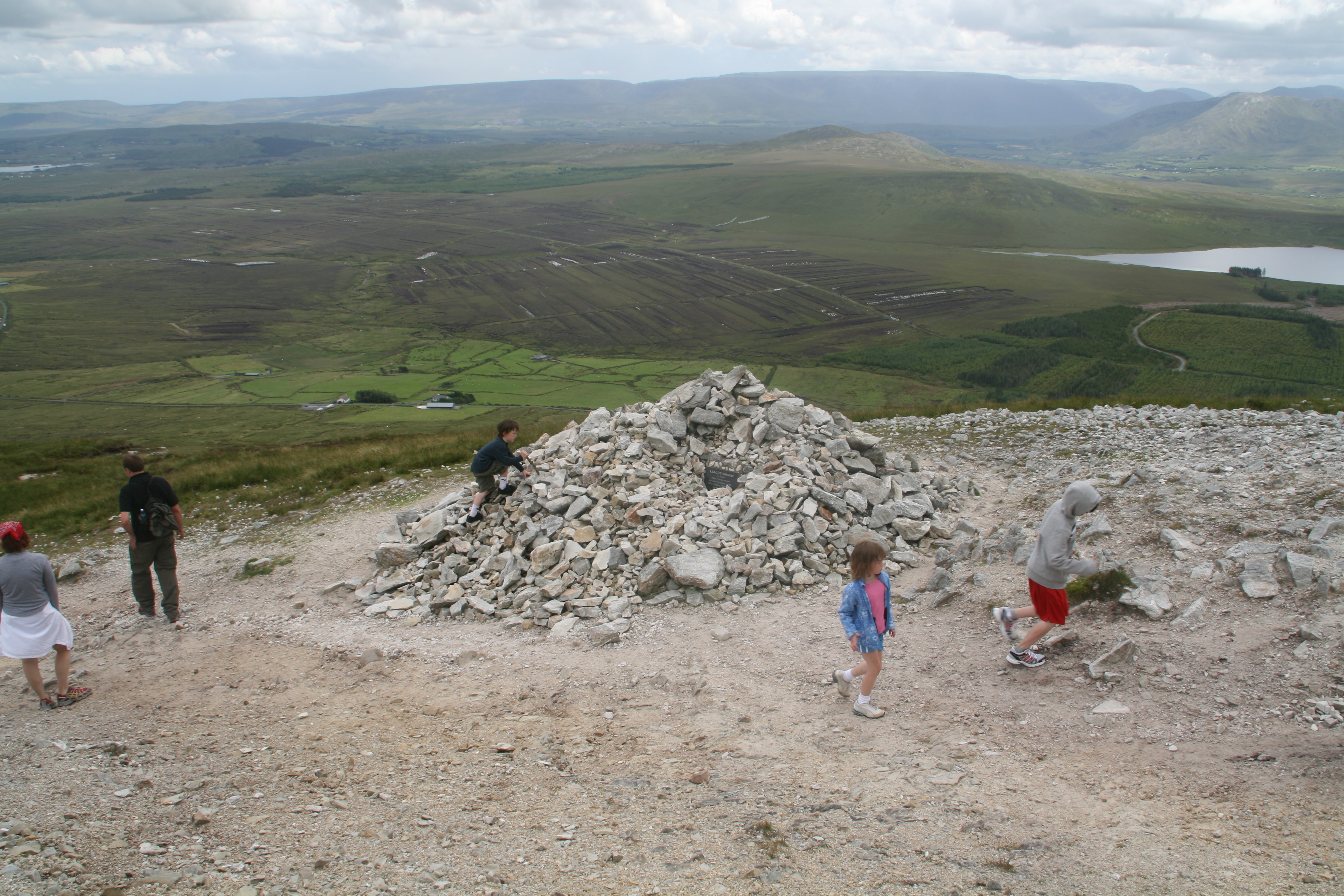 These cairns have now been incorporated into the Catholic pilgrimage experience as penance stations, and its easy enough to imagine them as part of the mountain itself since they are constructed of the same stone that covers the entire trail to the summit. The trail is another manmade structure that is easy to overlook as a part of the ‘natural’ landscape. Read more…
Animals and Warfare
NPR’s recent report on animals in the military has me thinking about our responsibility to our nonhuman companions, especially in situations of heightened risk. The US military now trains sea mammals in support of its navel operations: dolphins are taught to identify underwater mines or human invaders, while sea lions are taught to actually cuff swimming terrorists (question: what happens to the animals after locating a mine or terror-bent swimmer?). Both species will be deployed in Washington state by next year and Russian military officials are eager to mimic the strategy. Though I’ve read about military dogs in books (Ivan the dog in Frank McCourt’s ‘Tis and the bomb-laden sheep dogs in David Benioff’s City of Thieves), I haven’t really thought seriously about the consequences of using so many species as tools in warfare. The idea is sort of romantic, recalling the dæmons of Phillip Pullman’s imagination. But real animals are not extensions of human consciousness nor sympathetic participants in human military causes. So what sort of regulatory limitations exist to guide human-nonhuman military relationships?
Zubin Pastakia’s “The Built Landscape” series
A Facebook friend of mine posted a link to Zubin Pastakia’s photography this evening. I’ve never heard of Pastakia, an Indian photographer, and the link my FB pal provided initially led me to his photos of the interiors of Bombay’s old movie theaters. I first thought I might post here about this idea of interior landscapes that we touched on in regard to Edward Burtynsky’s photos of mines, quarries, and factories. But as I explored Pastakia’s website, I came across another series he is currently working on called “The Built Landscape.” These photos bring to mind Andrea’s post about Griffioen’s Detroit photography, decaying urban environments, Burtynsky’s similar concept of manufactured landscapes, and the possibility of reconsidering how we think of and define landscape itself.

BDD Chawl, Sewri, Mumbai, 2008 - Zubin Pastakia
“A Cloud Still Hangs Over Bhopal”
An op-ed marking the 25th anniversary of Bhopal in today’s NYT:
http://www.nytimes.com/2009/12/03/opinion/03mehta.html
There’s a really fascinating section on thinking about the gas as a kind of sentient organism. I wonder what it says that Mehta imagines (or imagines the people of Bhopal imagining) the gas as a living being that can make choices (like sparing one animal and not others). I’m pretty sure Animal would disapprove.
Of Ruined Cities and Feral Houses
I grew up in the Rustbelt; I spent my early childhood in Chicago and my adolescence (until about two years ago) in the metro-Detroit area. As some of you may know, Detroit’s in a bad way right now. Detroit’s real troubles started with the 1967 race riots and have only been compounded by political corruption and the death of the automobile industry.
For a more by-the-numbers understanding of exactly how bad things are, you can check out the 2000 US Census information (with updated estimates for 2006) here. Detroit’s population is has fallen from a peak of about 1.8 million to under 875,000 people (this number itself an 8.4% drop from the 2000 census!). In 1999, 26.1% of the population of Detroiters were living under the poverty line. I understand this has risen above 33% at this point but I can’t find official verification).
In light of our conversation today about Manufactured Landscapes, I am reminded of my home city…the decline in population hasn’t resulted in a decline of buildings. Many, many abandoned buildings remain. Read more…
Birds, Out of Context (Paul Bellew)
Anyone need a coffee table book? Do you like… birds?
The other day I stumbled on a website promoting the book Birds by Andrew Zuckerman. It’s a book of photography full of more than two hundred pictures of birds. To view some of the photos, go to the website and click on the “Photographs” link. From here you can navigate a list of species and see various pictures of birds and even listen to some of their calls. Some of these birds are even rare. Wow!
Local Dispatches Before a Global Conference (Sarah Todd)
As world leaders prepare to meet next week for the United Nations conference on climate change, The New York Times posted four essays from writers in Copenhagan, Japan, South Africa, and Brazil on how climate change is impacting their countries. You can check out the essays here.
Our Noble Fir
On Saturday afternoon, my husband Damon and I spent a few hours, a tank of gas and $5 on a permit to get a live Christmas tree from the National Forest. As I contemplate the pine-winey presence of this young Noble Fir in my living room, I wanted to share with you some of the environmental surprises this tradition poses for me.
According to the National Christmas Tree Association, Americans buy about 30 million real Christmas trees a year and the USDA reports that about a quarter of these come from Oregon. This year, thanks to the softening economy, Oregon’s tree farmers are in trouble. Mature, ready-to-harvest Christmas trees are staying in the ground, even though by next year they’ll be too big to harvest for home-use. Cost-conscious customers are either skipping a tree completely or going artificial. This latter alternative remains a thorn (or a blue spruce needle?) in the side of the tree farming industry.
As you might expect, artificial trees introduce problems into the seasonal cycle of Christmas tree growth, harvest, and replanting. Artificial trees are imported, inorganic (with scary levels of PVC) and non-recyclable. They’re flammable, chemically-laden, and can’t offer the scent or soulful experience of a real tree. In contrast, real trees can be sustainably farmed and are completely biodegradable (hello firewood!). If you’re going to get a Christmas tree, the NCTA wants you to go real or go home. Read more…
Ecocomposition and the Environmental Crisis (Stephen Siperstein)
Thank you Dan for posting about the place of environmental thinking in the 121 classroom and for starting the conversation about how our work in Environmental Literature, and specifically in 670, might inform the work we do in our other (and perhaps more important) roles at the University of Oregon. I am just now taking a break from reading through my students’ latest essays, and wanted to respond to your great post and meditate on some of my own thoughts about ecocomposition. The students’ essays which I am reading through had to in some way respond to “environmental issues” and specifically to several of the readings from our recent unit on the environmental crisis, which included selections from Terry Tempest Williams’ Refuge, Rachel Carson’s Silent Spring, Joyce Carol Oates’ “On Nature,” Martin Lewis’ Green Delusions: An Environmentalist Critique of Radical Environmentalism, as well as several handouts and flyers about climate change that I collected from 350.org. I began this latest unit with similar anxieties as those you describe in your post, but found that the joy and exhilaration of being able to engage with my students about issues that I feel passionate about more than made up for those fears.
As for the first two fears that you bring up; I don’t think we need to worry about our own political leanings or our own (lack of) expertise on the issues if we are forthright with our students about where we stand. I made it clear at the beginning of the unit, and for that matter at the beginning of the term, that the whole reason I was at the University of Oregon and even in front of their class was because of the environmental crisis. It’s the same reason why I’m in 670. So clearly I have certain opinions Read more…
 Environmental Literature + Media